
Horry County Resident Lookup Records
No official source supplies a complete list of Horry County residents. A useful resident lookup instead matches a specific question to the record that can answer it. The Assessor establishes a current parcel ownership and PIN trail. The Register of Deeds records parties to property instruments. The court index identifies a public case, while Probate can provide estate, will, guardian, and marriage context. DPH handles state vital-record requests. Each source has a different purpose, so a property record should not be read as a household list and a marriage certificate should not be read as a current-address record.
| Record channel | Fact it can support | Horry County route | Access boundary |
|---|---|---|---|
| Assessor and Land Records | Current parcel owner and PIN | Horry County Assessor | Address-bearing displays require a free county login. |
| Recorded documents | Parties, deed reference, and legal description | AcclaimWeb | County form documents name results since 1984. |
| Public court index | Whether a nonsealed indexed case appears | Horry Public Index | Case details and copies need careful review. |
| Probate and marriage | Estate context or a local public marriage certificate | Horry Probate Court | File access and redactions still govern. |
| Vital record route | Eligible vital event request or historic index lead | SC DPH Vital Records | Indexes, public records, and certificates differ. |
Choose the narrowest reliable starting point. A known address belongs with the parcel and deed channels. A case number belongs with the court system. A death, marriage, or birth year belongs with the proper vital or Probate route. For a name shared by several people, preserve the middle name, suffix, former surname, community, or dated event before expanding the search.
Checking Horry County Court Indexes
The Horry Public Index is for public case and docket research, not a directory of people. It requires JavaScript and cookies, acceptance of its disclaimer, and a security CAPTCHA validation before the live search. The documented controls include county, party name, case number, court type or agency, case type or subtype, party role, action type, tax-map number, and filed, disposed, judgment, or arrest date ranges. Name searching can use begins-with or partial text, which makes alternate spellings worth checking.
| County | Select Horry County for the Fifteenth Circuit route. |
|---|---|
| Party or person name | Use begins-with or contains or partial matching and compare variants. |
| Case number | Use this alternative path when a notice or clerk supplies it. |
| Court type, agency, case type, subtype, party role, action type | Optional filters documented by the Judicial Branch guide. |
| Date type and range | Filed, disposed, judgment, and arrest are documented date concepts. |
| Tax-map number | An optional pathway in applicable court searches. |
Case-number links can lead to case tabs, actions, and financial information, but a document icon does not promise that every underlying paper is online. Family, juvenile, adoption, sealed, expunged, and other protected material is not a general public-search category. The Horry County Courthouse and Clerk route are at 1301 Second Avenue in Conway, and the Clerk phone listed by the Judicial Branch is 843-915-5080.
The Horry Public Index screen shows the county-specific disclaimer and search entry point.
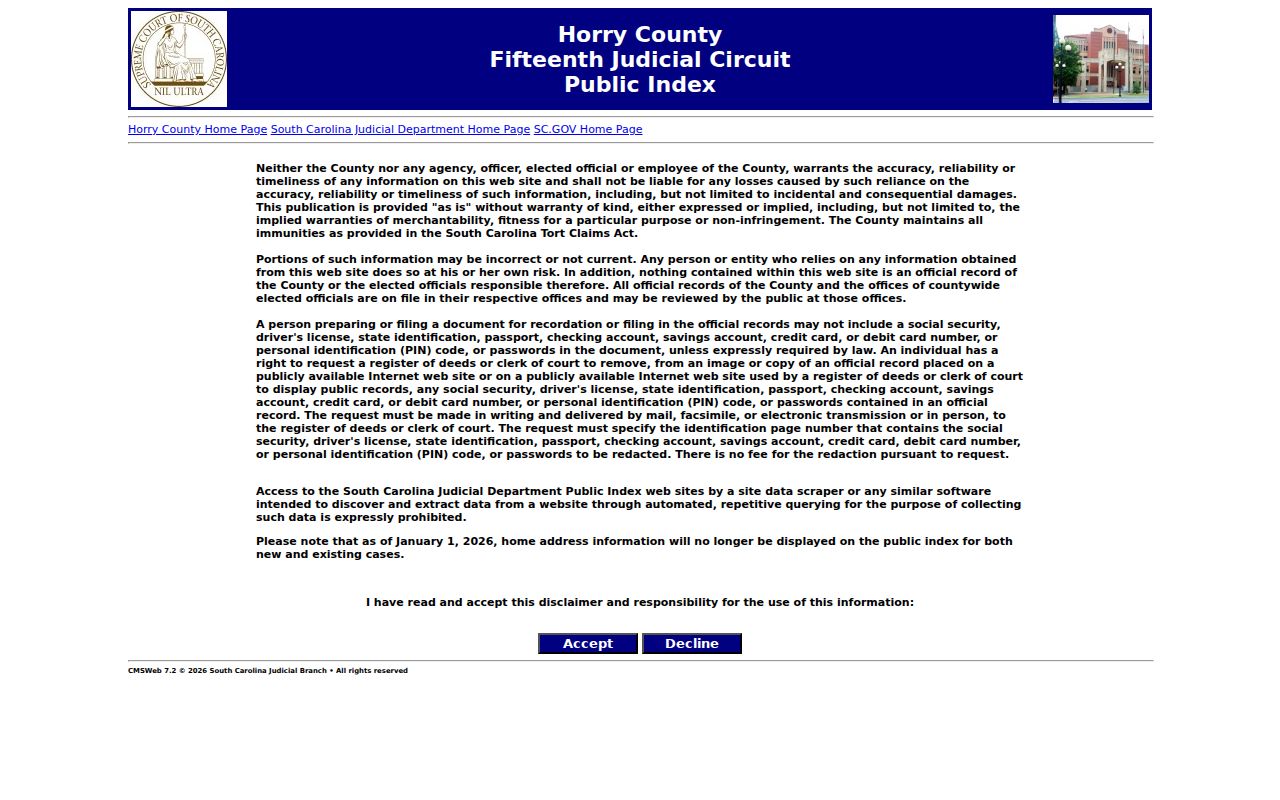
The displayed gate reinforces why a case result must be checked against the court, date, parties, docket events, and any permitted Clerk copy.
- Portal access requires the county route, JavaScript and cookies, disclaimer acceptance, and CAPTCHA validation.
- The inspected index route is expected to identify party names, court, case number, and docket events, but unviewed live fields are not promised here.
- Case-number links are the path to available detail; obtain a permitted copy from the Clerk when an underlying filing matters.
Verify a Horry County Resident
A careful Horry County resident lookup uses two independent record types, not two versions of the same list. Start by preserving the name exactly as received, then add a stable anchor such as a parcel PIN, legal description, spouse or estate relation, case number, business entity, or historic date. A current owner name plus a matching deed is stronger than a name alone. A court party plus a clerk-provided record can resolve a similar-name problem when the dates and parties agree.
- Record the complete name and try useful variants, including initials, former surname, suffix, and the Register of Deeds last-name-first-name format.
- Use an address or owner name to identify a PIN through the Assessor route, then compare the parcel record with the latest recorded deed.
- Search the court index by name or case number only when a public case is relevant, and compare court, date, parties, and docket events.
- Ask the responsible custodian for a permitted copy when the question depends on the actual instrument, certificate, or court file.
- Docket
- A court’s running record of a case and its events.
- Index and image
- An index identifies a record; an image is the underlying scanned document when the custodian makes one available.
- Certified copy
- A copy issued by the custodian with its certification, when that office permits one.
- PIN
- The property identifier that ties an Assessor entry to the parcel and deed trail.
Note: Record the retrieval date and the exact fact each source establishes before treating two names as the same person.
Horry County Vital Record Paths
South Carolina DPH Vital Records provides the state routes for births, deaths, marriages, and divorces. Its birth application says filing was not required until January 1, 1915, that DPH birth records are not open for public viewing, and that a birth record becomes public after 100 years. The same DPH service separates a historic index lead from an eligible certificate request. For a Horry marriage, Probate is a distinct local channel because it issues, records, and indexes licenses and says marriage licenses and certificates are public during regular business hours.
The DPH birth form asks for requester contact details, relationship or legal interest where required, the person’s name and birth details, parent information as needed, request type, signature and identification, and payment. It identifies a $12 public-birth search fee. For death, marriage, and divorce, use the current DPH form and fee information because the eligibility and coverage rules are separate. A Horry Probate marriage certificate may be requested by the local process, with $5 per copy for 1994-forward records and $10 research plus $5 per copy for earlier records.
See the DPH Vital Records service before choosing a form or submission route.
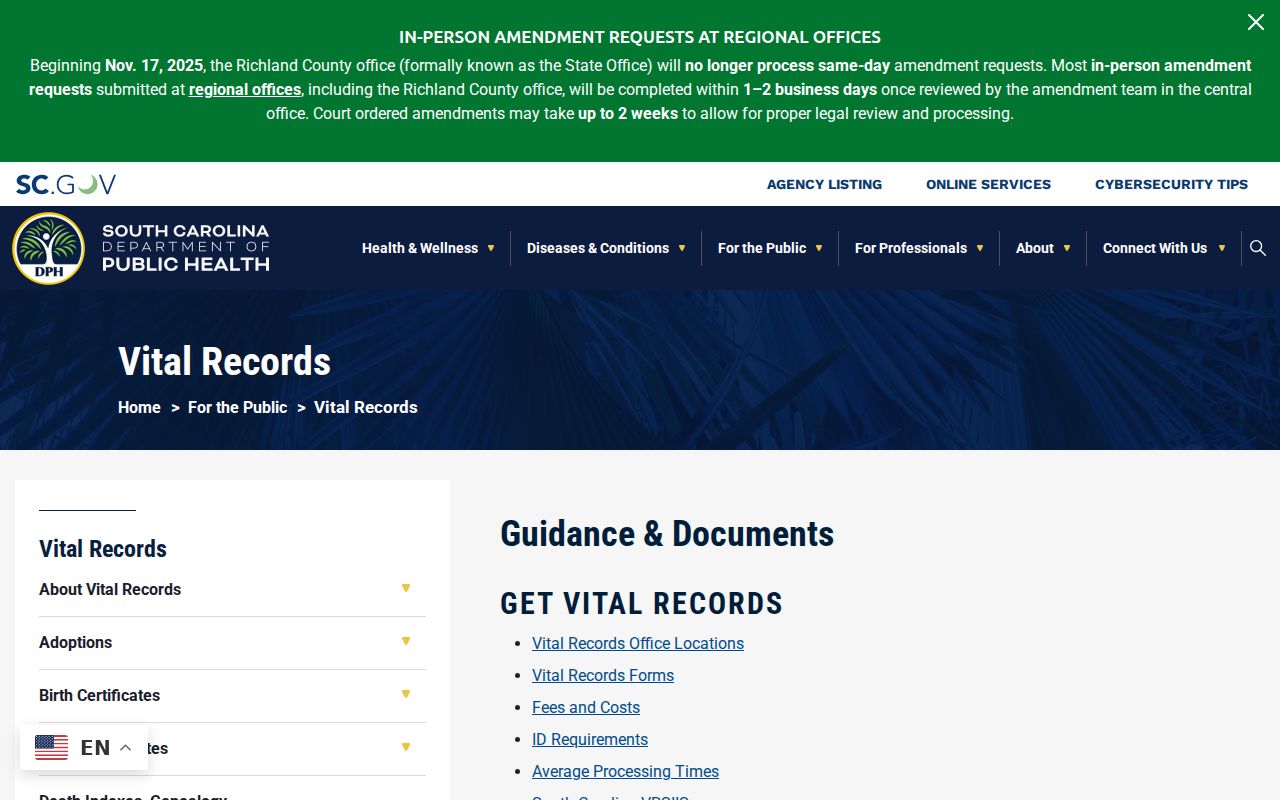
The DPH service separates record applications and historic-genealogy material, which keeps a resident lookup from treating a certificate policy as an open-name index.
The Horry Probate marriage-license service states the local license and certificate route.
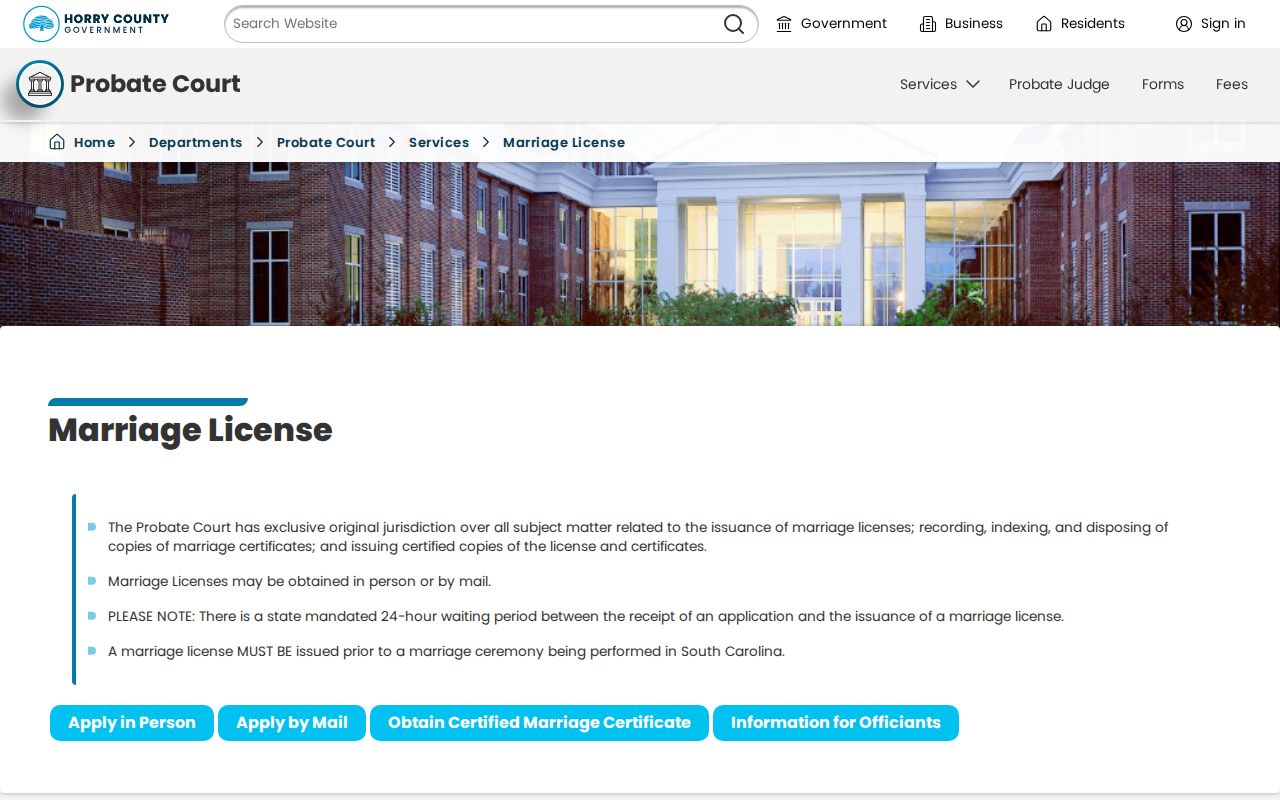
The county marriage path is public during regular court hours, but a marriage event still does not establish a person’s current address.
Horry County Voter Lookup Boundary
MyscVOTES Voter Information is an authenticated personal route. It asks for Horry County, first and last name, date of birth, and the last four digits of the Social Security number as they appear on the voter-registration card. It is not a public name-browse tool. The county Voters Registration and Elections Office can direct address and precinct questions, but registration does not reveal ballot choices and South Carolina does not use ordinary party registration.
State voter-list production is a different, regulated channel available to registered South Carolina voters under S.C. Code §7-3-20(D)(13). Its documented criteria can include county, voting district, age, sex, race, household, participation, and registration date. That controlled file process does not turn MyscVOTES into an anonymous way to inspect a person’s record. S.C. Code §30-2-50 also restricts commercial solicitation using public records.
Use the MyscVOTES sign-in route only for its stated personal-information purpose.
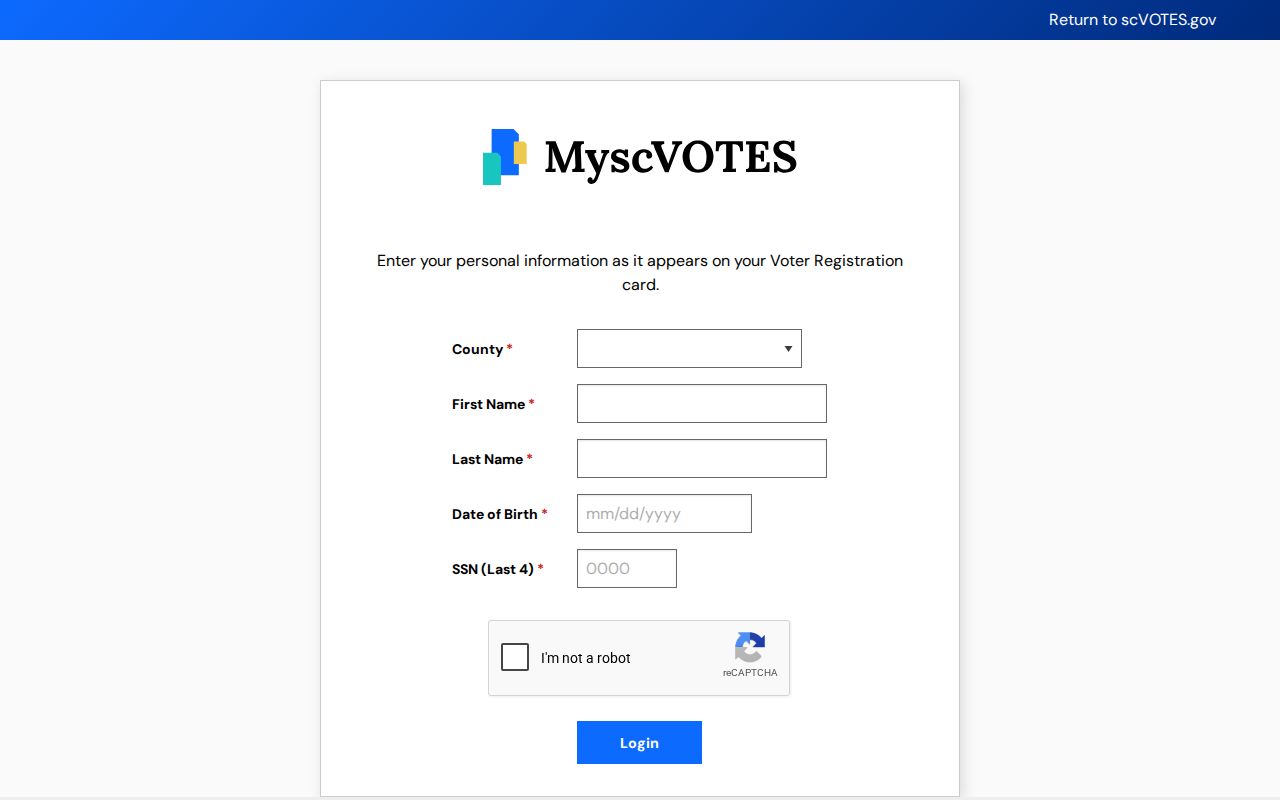
The login requirements make the boundary visible: this channel confirms an authenticated voter’s information, not a general Horry County resident roster.
Horry County Heir Record Trail
For a family-history heir question, begin with the Horry Probate Court estate or will file, then compare an obituary, recorded deed, cemetery source, and an eligible DPH record. Estate material can identify personal representatives, beneficiaries, or notice addresses, but the actual file and its redactions control what may be copied. Probate requires an appointment to open an estate in person, and a will must be filed within 30 days of death when one exists.
Older family trails may need the Horry County Memorial Library, the Horry County Historical Society, or the Horry County Archives Center at Coastal Carolina University. Library-held census, yearbook, obituary, newspaper, and archival material can provide context when an official current-record route ends. It remains context until a custodial record confirms the needed fact.
Horry County Booking Search Limits
The Horry County Bookings and Releases search is limited to people booked at the J. Reuben Long Detention Center. Its visible fields are last name, booking date, and release date. The displayed roster can include name, ethnicity or sex, date of birth or age, booking and release dates, booking number, and arresting agency. That limited record is neither a complete Horry County resident lookup nor proof of a conviction.
Use a matching court record and the relevant agency to check a charge, case, release, or disposition. The Sheriff states it never collects payment over the phone, so an unexpected demand should be verified through the official Booking channel or the Magistrate’s Office rather than through a caller.
The Bookings and Releases search shows the county’s stated fields and disclaimer.
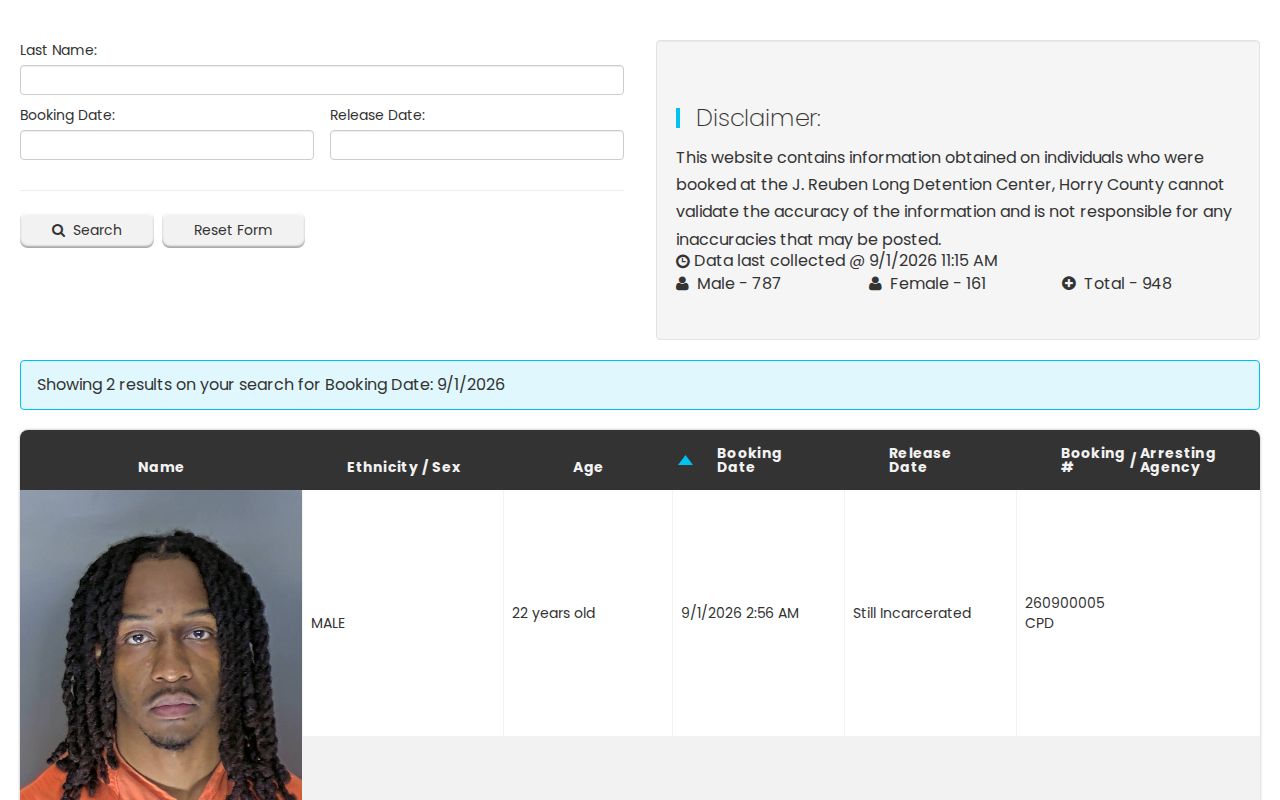
This narrow search is best treated as a detention-center record with its own scope, not as evidence that a person lives at a particular address.
Horry County Lookup Fallbacks
When an online result stops short, contact the office that created the record. The March 2026 county access change requires a free account for GIS, Land Records, Tax, and Assessor services that display property addresses. A person who cannot use that route can call the Assessor, visit the appropriate county counter, or make a narrowly described request. Recorded deeds use the Register of Deeds copy process rather than a county FOIA request.
South Carolina’s Freedom of Information Act, S.C. Code Ann. §§30-4-10 to -165, supplies a request route for a public body’s nonexempt records. A request works best when it identifies the record, date range, subject, and custodian. It does not open sealed court files, restricted vital records, or protected address information. Ask HCML, Thompson Heritage, HCHS, CCU Archives, or SCDAH about historical material when a current portal has no older answer.
Horry County Resident Lookup Limits
Missing information can be a lawful privacy boundary, not a problem to work around. South Carolina’s Address Confidentiality Program supplies a substitute address for eligible participants dealing with state and local agencies and courts. Protected voter information, juvenile and sealed court matters, restricted vital records, motor-vehicle information, utility accounts, and nonpublic household-member information have their own limits. An absent or alternate address must never be used to infer a protected location.
If a government record appears wrong, contact the custodian: the Assessor for ownership listing information, the Register of Deeds for recording or index questions, the election office for registration, the Clerk or Probate Court for a court file, and DPH for vital-record correction. South Carolina also provides a no-fee route to request redaction of specified sensitive identifiers from a public online ROD or Clerk image while the official original remains intact.
Lawful use. Use a Horry County resident lookup for lawful personal, family-history, civic, or property research. Do not use a record match to stalk, harass, threaten, or expose any person.