
Horry County City Directory Shelves
The first task is locating a volume, not assuming that a directory series covers all of Horry County. The reviewed HCML pages confirm local-history resources and a Heritage Library, but they do not publish a shelf-level list of Conway or Myrtle Beach city-directory publishers, years, or reverse volumes. That absence matters. A city directory is often a city snapshot, while rural routes and unincorporated communities may be missing. Ask the holding institution to verify the title, city, publisher, and date before treating a listing as evidence.
| Collection or source | Verified scope | Keeper | Access route |
|---|---|---|---|
| Conway and Myrtle Beach city directories | Exact publishers and year runs were not published in the reviewed online shelf information | Thompson Heritage and Research Library / HCML catalog | Ask staff to confirm title, year, format, and on-site rule |
| Reverse or criss-cross directories | Potential address-to-name source where a volume exists; no countywide online run verified | Heritage Library / HCML | Catalog or closed-stack inquiry |
| Local historical material | Photographs, oral histories, manuscripts, and county research resources | Horry County Archives Center Digital Commons | Online collection and research-room channel |
| Newspapers and local history | Historical Society resources and documented Horry newspaper titles | Horry County Historical Society / USC | Online leads, library, and original page checking |
Do not fill the catalog gap with a generic publisher claim. A negative answer for a year or format is useful research evidence. Preserve it, then use the newspaper, census, deed, or probate route that matches the question.
Thompson Library for Horry City Directories
The Thompson Heritage and Research Library is the practical first counter for a Horry city-directory question. It opened on January 30, 2025 and is at 1008 5th Avenue in Conway. HCML lists 843-915-5222 and Monday through Friday hours of 10 a.m. to 4 p.m. Call before a trip, then ask for a Conway or Myrtle Beach city directory, a telephone directory, a reverse directory, a criss-cross volume, a Polk or Cole title, and the historic street or place name. Staff can also say whether an item is on site, on microfilm, digitized elsewhere, or held by another library.
Start with the HCML Local History gateway, which identifies genealogy and local-history resources, including HeritageQuest, FamilySearch, archives links, and Ancestry Library Edition. Ancestry access is specifically limited to use within the library. That makes the library visit or staff-assisted route important when an older name is not exposed in an ordinary online search.
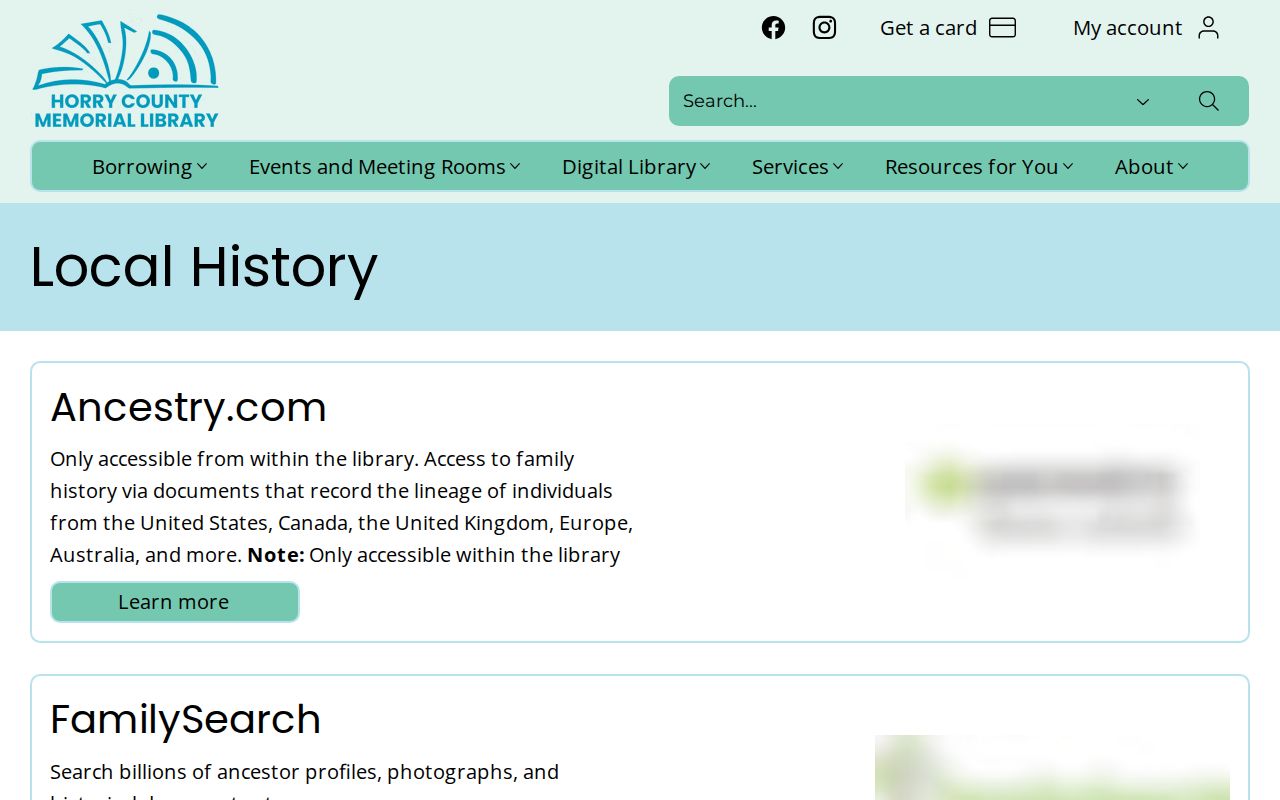
The HCML screen is a starting point for collections and referrals, not proof that a particular city-directory year is digitized or available for remote viewing.
The Missing Horry City Directory Inventory
HCML’s reviewed public pages do not supply the publisher-and-year inventory needed to name a local directory run with confidence. Request a catalog search under the place, format, and likely publisher terms instead of asking only for a surname. Useful terms include “Conway city directory,” “Myrtle Beach city directory,” “Horry County telephone directory,” “reverse directory,” “criss-cross,” “Polk,” “Cole,” and “street directory.” Include an older community or street name where known.
Ask for the first, last, and nearby years around an address or event. Also request the title page, the abbreviation key, and the access condition. A blank result can mean a rural route was omitted, the needed volume is absent, or the listing used a different spelling. It does not establish that a person never lived in Horry County.
Note: Record the library’s response when a requested directory or reverse volume cannot be found, then choose a dated alternative rather than inventing a coverage run.
Horry City Directories at CCU and HCHS
When the local library catalog cannot bridge a name or address, the Horry County Archives Center Digital Commons at Coastal Carolina University offers local research material, photographs, oral histories, and the Independent Republic Quarterly. The physical research room is listed at Kimbel Library, Room 220, 376 University Boulevard, Conway, 843-349-4056; confirm hours before visiting. Its Waccamaw Collection and 266 microfilm reels of historic land records can supply place or land context, but neither is a substitute for a city-directory volume.
The Horry County Historical Society, founded in 1966, adds historical markers, photographs, oral histories, newspapers, newsletters, genealogies, and county-history referrals. Genealogies are useful surname leads but remain material to check against original records. Historic context can resolve a spelling or community question without turning a story source into legal proof of residency.
The Historical Society collections are a useful companion when a city-directory request needs a surname, local-place, or newspaper lead.
The collection landing page identifies historical material that can help frame a search, while the requested directory title and page still need to be verified separately.
Read a Horry County City Directory
No official source reviewed for this project exposed a digitized Horry, Conway, or Myrtle Beach directory page that could be represented as a local sample. Once a volume is supplied, inspect it as a record with its own context. A normal city-directory entry may give a name, occupation or employer, spouse or widow notation, and street address. Those details are research leads. They need the exact volume title and page so that another researcher can check the same listing.
| Title and page | Capture the exact city, publisher, year, title page, and entry page. |
|---|---|
| Name form | Preserve spelling, initials, and any variation exactly as printed. |
| Household clues | Note spouse or widow language, occupation or employer, and the street address if shown. |
| Address clues | Record a residence, telephone, owner, or other status mark only when the specific volume defines it. |
| Abbreviations | Photograph or transcribe the volume’s key before expanding an abbreviation. |
- Criss-cross directory
- An address-order section that can point from a street address to a listed name, if the volume includes one.
- Householder index
- An index organized around the listed household or address, whose exact arrangement must be checked in that edition.
- Abbreviation key
- The volume’s own explanation of shortened terms and symbols; it should be captured before interpreting an entry.
Historic Horry City Directory Names
Place names can break an otherwise careful city-directory search. Local historical material identifies Kingston as becoming Conwayborough in 1801 and Conway in 1883. Search those forms alongside Conway when checking older newspapers, archives, maps, or library catalogs. The change is an index clue, not evidence that every result under one term refers to the same address or person.
Horry’s documented record history also gives a reason to work across sources. The county was formed in 1801, and courthouse offices were vandalized in 1865. Many loose papers and clerk volumes were lost, including early deeds through 1828; equity files were nearly wiped out. A directory entry, newspaper notice, map, or archival item may be the surviving dated clue that tells a researcher which official record to seek next.
| 1801 | Kingston became Conwayborough, a useful historic search term. |
|---|---|
| 1865 | Courthouse vandalism caused major losses in early county records. |
| 1883 | Conwayborough became Conway, another catalog and newspaper search variant. |
| 1966 | Horry County Historical Society was founded. |
| 2025 | Thompson Heritage and Research Library opened in Conway. |
Trace Horry County City Directory Households
Use a city directory as one dated observation, then build outward. The National Archives releases federal census schedules after 72 years, so pair a located directory year with the closest released census rather than assuming an annual listing proves a whole decade. A deed, probate record, obituary, or cemetery record can distinguish a recorded property party from an adult child or another person at the same address.
- Save the directory’s exact name, address, title, year, and page.
- Ask whether a nearby-year or reverse volume exists, then compare the spelling and address rather than merging similar names.
- Pair the listing with the closest released census through HCML’s genealogy resources or another official archival route.
- Use the parcel PIN, legal description, and Register of Deeds trail to distinguish a property party from an occupant when land is involved.
- Check probate, obituary, cemetery, or original newspaper evidence for a move, death, or family relationship.
A listing disappearing between years has several possible explanations. The household may have moved, a name may have changed, the publisher may have altered its coverage, or the person may simply not have been listed. The next source should answer that specific uncertainty, not force a conclusion from silence.
Horry City Directory Gaps After 1865
The SCDAH Horry County records summary documents both losses and surviving series. It lists conveyance books from 1803 to 1977, probate estate papers from 1803 to 1931, will books from 1819 to 1907, and marriage licenses from 1911 to 1950, while warning that availability and images must be checked. Those dates describe historical record series, not a promise of online access or an unbroken personal trail.
Historic newspapers are often the best gap-filler. USC’s Horry collection documents The Horry Dispatch (1861-63), Horry News (1869-77), The Telephone (1878-83), The Horry Herald (1886-1923), and The Field (1903-58). OCR can find a promising name or address, but the original page image should be checked before relying on it. The USC Horry newspaper collection provides that dated alternative when the city-directory shelf has a gap.
The county’s cemetery project supplies another family-history lead. It was begun to inventory, map, and preserve historic gravesites, including long-lost or unmarked graves identified with ground-penetrating radar, and connects marker information with GIS. A grave or obituary can help test a household endpoint suggested by a directory. It still needs original-record corroboration for a legal, identity, or lineage conclusion.